Baby Linen
or How to Make a Basic Essential Layette
for Eighteenth Century Re-enactor Infants
Petticoat
The petticoat was worn over the shirt and napkin, and its waistband held the shirt closed. As with the napkin and pilch, there appear to be no known surviving 18th c. examples, so in lieu of an extant surviving example, here is a description from "The Nursery-Maid", in Hannah Glasse’s The Servant’s Directory, 1762 p.44: "a petticoat of fine flannel, two or three inches longer than the child’s feet; with a dimity top (commonly called a boddice coat) to tye behind."
To make the petticoat to match Mrs. Glasse’s description, you’ll want to make the skirts of it out of thin wool flannel and the waistband out of heavy cotton or linen. For an infant, the fabrics should all be white. If you don’t want to buy wool flannel, have concerns about wool-allergies, or have lots of white linen on hand, you can make the petticoat skirt from linen. Cotton is not recommended, as it gets clammy when damp, in a way that linen and wool don’t.
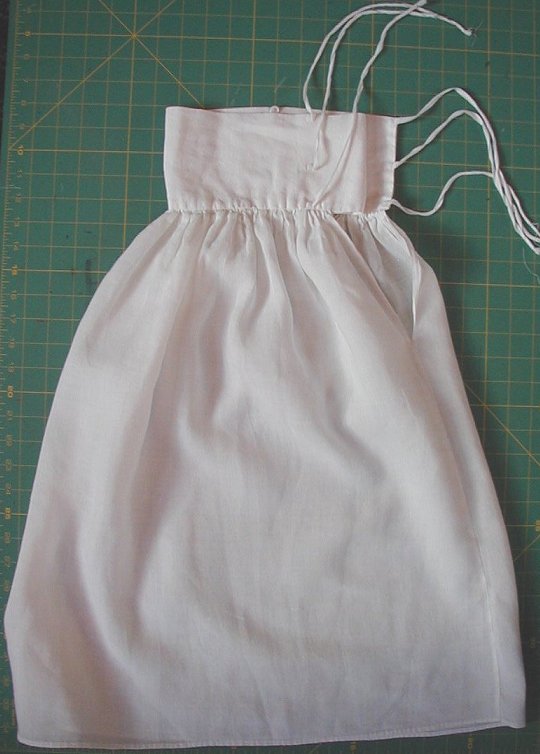 |
1. Cut the waistband 8 ½" x 15 ½". This allows for ¼" seam allowances. Cut the skirt panel roughly 22" to 24" long x 24" to 36" around. The dimensions of the petticoat skirt panel don’t have to be precise, but resist the impulse to skimp on fabric by making the petticoat skirt any narrower than 24". The petticoat will look much better if it is nice and wide, and you’ll be glad you made it wide every time you have to change a diaper! 2. Pleat or "stroke-gather" the top edge to equal 15" and sew it to one of the long sides of the waistband. Fold over the waistband and, turning under all raw edges, slipstitch three sides of waistband so that the gathered edge of the petticoat top is enclosed and all raw edges of waistband are enclosed. Finished waistband should measure 4" x 15". |
3. Sew the side seam of petticoat skirt, leaving the waistband and upper 5" to 6" of the skirt open for a placket. Finish the edges of the placket with narrow hems. Hem the bottom edge of the petticoat skirt with a narrow hem. If you are using wool flannel, you can turn the hem under only once, not twice, before slipstitching it.
4. To fasten the petticoat around the baby, you could use a separate belly band, but I recommend adding tape-ties as follows: Cut 6 pieces of white cotton twill tape, ¼" or ½ wide, and 12" long. Sew three of them to the edge of one 4" end of the petticoat waistband. Sew the other three at the other 4" end, only not at the very edge; sew them about 2" in from that edge, on the outside of the petticoat. When you tie the petticoat around the baby, you can adjust the overlap to accommodate for size.
Options:
1. If you want a good 18th c. appearance for Junior, you can insert extra interfacing to stiffen the petticoat waistband, before you sew it all around. This will give it more of the effect of a support-garment. Topstitching around the edges of the waistband will also help stiffen it.
2. Option for ornamentation: In the absence of surviving originals, it’s hard to say how these petticoats might have been decorated. You can make a more lavish looking petticoat by choosing the longer and fuller dimensions given for the petticoat skirt, 24" long x 36" around. (In any case, the petticoat hem shouldn’t stick out below the hem of the bed gown, so if you choose to do this, be sure to make the bed gown more lavishly long to match.) You might make a petticoat of fine linen to go over the wool flannel petticoat. You could probably put a few decorative horizontal tucks around the hem of the linen one, like "growth-tucks". For each ½ tuck, cut the petticoat skirt 1" longer.
The petticoat is worn over the napkin and shirt, and is what holds the shirt front shut. It should be tied just snug enough to hold all the other layers in place. Since it is supposed to be providing abdominal support, it is best to tie it at the side or back. In practice, you’ll find it will stay in place best if it is positioned up under the baby’s armpits and slightly above its belly.

pattern diagrams may be copied for personal use,
all other rights reserved
http://villagegreenclothier.com/showroom/infantclothes.html
-
Introduction
- Cap
- Diaper, known in the period as "napkin" or "clout"
- Pilch or Pilcher, a diaper-cover
- Shirt
- Petticoat
- Roller, swaddling-band, belly-band, or "surcingle"
- Bed gown or robe
- Bib, also Drool cloth, burp cloth, the "muckinder"
- Stockings, Shoes, Booties
- Baby sling, baby carrier
- Blanket, basket, bedding
- Final Reminder
Sources
Baby Swaddling Photo Series
Baby Gown Photo Series

Home